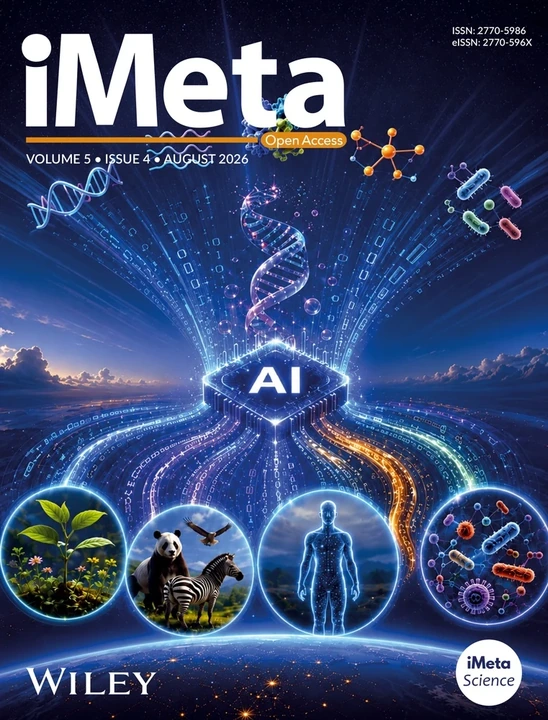
Paper Review Records
All Paper Review Records
27 valid samples · Newest publication first
Review days = acceptance date − received date. PDF, DOI, and publisher-page sources are retained.
41
days
Maternal microbiota shapes brain and neuroendocrine development in piglets
Authors
Leli Wang; Chao Yan; Lei Li; Yuankun Deng; Hua Shao; Kuo Long; Cimin Long; Yuanyuan Zhu; Meiqing Chen; Jialu Huang; Jinghua Jiang; Ziyi Lin; Yunying Yao; Tao Yang; Wenbin Guo; Liangpeng Ge; Jing Sun; Yuchun Ding; Zuohua Liu; Mingzhu Yin; Yulong YinShow moreShow less
Affiliations
1. Institute of Subtropical Agriculture Chinese Academy of Sciences Changsha China; 2. College of Animal Science and Technology Hunan Agricultural University Changsha China; 3. Shenzhen Branch, Guangdong Laboratory of Lingnan Modern Agriculture, Key Laboratory of Livestock and Poultry Multi‐omics of MARA, Agricultural Genomics Institute at Shenzhen Chinese Academy of Agricultural Sciences Shenzhen China; 4. Faculty of Life and Health Sciences Shenzhen University of Advanced Technology Shenzhen China; 5. Clinical Research Center, Medical Pathology Center, Cancer Early Detection and Treatment Center and Translational Medicine Research Center Chongqing University Three Gorges Hospital, Chongqing University Chongqing China; 6. Hunan Institute of Animal and Veterinary Science Changsha China; 7. Institute of Medicinal Plant Development Beijing China; 8. Huazhi Biotechnology Co. Ltd Changsha China; 9. National Center of Technology Innovation for Pigs, Chongqing Academy of Animal Sciences, Key Laboratory of Pig Industry Science Ministry of Agriculture Chongqing ChinaShow moreShow less
30
days
Integrative genomics and regulomics reveal the molecular architecture of complex traits in domestic chickens
Authors
Wei Han; Chenghao Zhou; Yuxin You; Guohui Li; Yunfen Zhu; Yijun Tang; Tao Zeng; Huiyong Zhang; Qian Xue; Jianmei Yin; Li Chen; Xing Ju; Yixiu Jiang; Jiaqi Cai; Lu Li; Xiaofeng Zhang; Zhaoyu Lin; Jindong Ren; Lizhi Lu; Dijun ChenShow moreShow less
Affiliations
1. Jiangsu Institute of Poultry Science Yangzhou China; 2. Key Laboratory of Livestock and Poultry Resources (Poultry) Evaluation and Utilization, Ministry of Agriculture and Rural Affairs Yangzhou China; 3. State Key Laboratory of Pharmaceutical Biotechnology, Nanjing Drum Tower Hospital, School of Life Sciences Nanjing Nanjing University China; 4. Institute of Animal Husbandry and Veterinary Science, Zhejiang Academy of Agricultural Sciences Hangzhou China; 5. National Resource Center for Mutant Mice of China, Ministry of Education Key Laboratory of Model Animal for Disease Study, Model Animal Research Center, Nanjing Drum Tower Hospital, School of Medicine, Nanjing University Nanjing China; 6. Chemistry and Biomedicine Innovation Center, Nanjing University Nanjing ChinaShow moreShow less
41
days
Artificial intelligence models Traditional Chinese Medicine principles to integrate with biomedicine
Authors
Haoran Li; Xingye Cheng; Ziyang Huang; Jingyuan Luo; Qianqian Xu; Qiguang Zhao; Tianchen Guo; Yumeng Zhang; Linda L. D. Zhong; Zhaoxiang Bian; Leihan Tang; Aiping Lyu; Liang TianShow moreShow less
Affiliations
1. Department of Physics Hong Kong Baptist University Hong Kong SAR China; 2. School of Chinese Medicine, Hong Kong Baptist University Hong Kong SAR China; 3. Vincent V.C. Woo Chinese Medicine Clinical Research Institute, Hong Kong Baptist University Hong Kong SAR China; 4. Centre for Chinese Herbal Medicine Drug Development, Hong Kong Baptist University Hong Kong SAR China; 5. School of Biological Sciences, Nanyang Technological University Singapore Singapore; 6. The Chinese Medicine Hospital of Hong Kong Hong Kong SAR China; 7. Center for Interdisciplinary Studies and School of Science, Westlake University Hangzhou China; 8. State Key Laboratory for the Modernization of Classical and Famous Prescriptions of Chinese Medicine, Jiangxi University of Chinese Medicine Nanchang China; 9. Institute of Systems Medicine and Health Sciences, Hong Kong Baptist University Hong Kong SAR China; 10. Institute of Computational and Theoretical Studies, Hong Kong Baptist University Hong Kong SAR ChinaShow moreShow less
42
days
Cross species metabolic complementation of vitamin K2 biosynthesis determines emergent suppression of tomato Fusarium wilt
Authors
Lizhi Zhao; Yuhui Li; Jianning Zhao; Alexandre Jousset; Francisco Dini‐Andreote; Lu Tan; Xiujing Guan; Yan Xu; Zhong WeiShow moreShow less
Affiliations
1. Agro‐Environmental Protection Institute Ministry of Agriculture and Rural Affairs (MARA) Tianjin China; 2. Key Laboratory of Original Agro‐Environmental Pollution Prevention and Control, MARA Tianjin China; 3. Tianjin Key Laboratory of Agro‐Environment and Agro‐Product Safety Agro‐Environmental Protection Institute, MARA Tianjin China; 4. Jiangsu Key Laboratory of Organic‐based Fertilizer Creation and Soil Health Manipulation, Key Lab of Organic‐Based Fertilizers of China Nanjing Agricultural University Nanjing China; 5. Jiangsu Collaborative Innovation Center for Solid Organic Wastes, Educational Ministry Engineering Center of Resource‐saving fertilizers Nanjing Agricultural University Nanjing China; 6. Department of Plant Science & Huck Institutes of the Life Sciences The Pennsylvania State University University Park Pennsylvania USA; 7. The One Health Microbiome Center, Huck Institutes of the Life Sciences The Pennsylvania State University University Park Pennsylvania USA; 8. College of Agro‐Grassland Science Nanjing Agricultural University Nanjing ChinaShow moreShow less
55
days
Vitamin K2 ameliorates pregnancy‐ and lactation‐associated osteopenia and postpartum depression
Authors
Wanqiong Yuan; Jing Hang; Jialin Jia; Jie Huang; Xuanqi Zheng; Huan Wang; Tong Wu; Hao Liu; Junxiong Zhu; Chenggui Zhang; Jinwen He; Yundi Zhang; Hong Wang; Xin Xiong; Na He; Haofan Bai; Jiamin Yan; Huijie Leng; Weili Zhu; Yingsheng Xu; Jie Shi; Chunli SongShow moreShow less
Affiliations
1. Department of Orthopedics Peking University Third Hospital Beijing China; 2. Engineering Research Center of Bone and Joint Precision Medicine, Ministry of Education Beijing China; 3. Beijing Key Laboratory of Advanced Bioadaptable Orthopedic Implants Beijing China; 4. State Key Laboratory of Female Fertility Promotion, Center for Reproductive Medicine, Department of Obstetrics and Gynecology Peking University Third Hospital Beijing China; 5. National Clinical Research Center for Obstetrics and Gynecology, Key Laboratory of Assisted Reproduction, Ministry of Education Beijing Key Laboratory of Reproductive Endocrinology and Assisted Reproduction Beijing China; 6. Beijing Advanced Center of Cellular Homeostasis and Aging‐Related Diseases, Institute of Advanced Clinical Medicine Peking University Beijing China; 7. Department of Orthopedics, Beijing Chaoyang Hospital Capital Medical University Beijing China; 8. Department of Orthopedics Surgery, The Second Affiliated Hospital Zhejiang University School of Medicine Hangzhou China; 9. Department of Orthopaedics Shandong Provincial Hospital Affiliated to Shandong First Medical University Jinan China; 10. Department of Pharmacy Peking University Third Hospital Beijing China; 11. School of Basic Medical Sciences Peking University Beijing China; 12. National Institute on Drug Dependence and Beijing Key Laboratory of Drug Dependence Research Peking University Beijing China; 13. Department of Neurology Peking University Third Hospital Beijing ChinaShow moreShow less
48
days
Infection mechanisms of Rhizoctonia cerealis in wheat
Authors
Yan Ren; Ti Liu; Heying Zhao; Qirun Qian; Lufei Cui; Zhipeng Sun; Wenkai Yang; Peng Guo; Sisheng Wang; Lingran Zhang; Congwei Sun; Aolin Jia; Ning Zhang; Feng ChenShow moreShow less
Affiliations
1. State Key Laboratory of High‐Efficiency Production of Wheat‐Maize Double Cropping, Agronomy College Henan Agricultural University Zhengzhou ChinaShow moreShow less
FAQ
How long does iMeta take to review a manuscript?
As of 2026-11-17, CrushSCI has 27 complete review records for iMeta. The fastest paper went from submission to acceptance in 20 days (Antiviral defense systems drive persistence of antimicrobial‐resistant bacteria but limit the transfer of antimicrobial resistance genes in anaerobic digestion, received 2026-05-19, accepted 2026-06-08); the slowest took 91 days. The average is 51.7 days and the median is 47 days.
Expert Matching · Case Demo
Turn Your Submission Goalsinto a Verifiable Journal Plan
Share your field, deadline, and author profile. CrushSCI uses real review records to suggest a title direction, shortlist journals, and estimate timelines.

