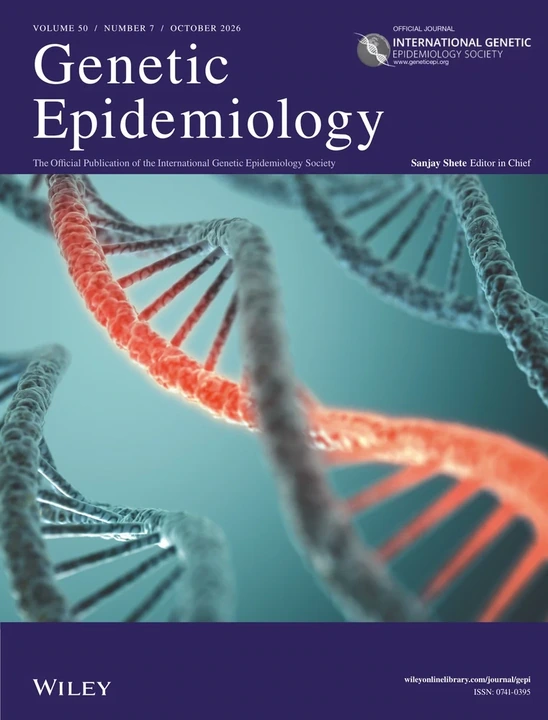
Paper Review Records
全部论文审稿周期
19 篇有效样本 · 按发表日期由新到旧排列
审稿天数=录用日期-收稿日期;保留 PDF/DOI/网页源链接
257
天
Genes That Reliably Differentiate Liver‐Fibrosis Stages Identified Using a Novel Integrated Statistical and Machine‐Learning Algorithm
作者
Vivekananda Mallik; Pranoy Naskar; Abhijit Chowdhury; Ankita Chatterjee; Nikhil Ranjan Pal; Partha P. Majumder展开收起
作者单位
1. John C. Martin Center for Liver Research and Innovations Kolkata India; 2. Indian Statistical Institute Kolkata India展开收起
274
天
Adjusting for Medication Use in GWAS and Its Impact on Mendelian Randomisation Analyses: An Example of Systolic Blood Pressure in UK Biobank
作者
Aaron Jun Yi Yap; Aimee L. Hanson; Gareth J. Griffith; Eleanor Sanderson展开收起
作者单位
1. Medical Research Council (MRC) Integrative Epidemiology Unit University of Bristol Bristol UK; 2. Population Health Sciences, Bristol Medical School University of Bristol Bristol UK展开收起
311
天
Multi‐Trait GWAS Analyses of Blood Pressure Traits Provide Limited Gains in Locus Discovery or Polygenic Risk Score Performance Compared to Single‐Trait GWAS
作者
Yujia Ma; Anna D. Argoty‐Pantoja; Tian Xie; Michael R. Barnes; Patricia B. Munroe; Claudia P. Cabrera; Harold Snieder; Helen R. Warren; UMCG Genetics Lifelines Initiative (UGLI) group author: LifeLines Cohort Study展开收起
作者单位
1. Department of Epidemiology University of Groningen, University Medical Center Groningen Groningen the Netherlands; 2. Department of Non‐communicable Chronic Disease Control and Prevention Beijing Center for Disease Prevention and Control Beijing China; 3. Guangzhou National Laboratory Guangdong Province Guangzhou China; 4. William Harvey Research Institute, Barts and The London Faculty of Medicine and Dentistry Queen Mary University of London London UK; 5. National Institute for Health and Care Research, Barts Cardiovascular Biomedical Research Centre Queen Mary University of London London UK展开收起
227
天
Imputed Rare‐Variant Aggregate Analysis Is a Powerful Approach to Detect Genetic Associations
作者
Tianyi Liu; Paul L. Auer; Gao T. Wang; Elnaz Naderi; Andrew T. DeWan; Suzanne M. Leal展开收起
作者单位
1. Center for Statistical Genetics, Gertrude H. Sergievsky Center, Department of Neurology Columbia University Medical Center New York New York USA; 2. Division of Biostatistics, Data Science Institute, and Cancer Center Medical College of Wisconsin Milwaukee Wisconsin USA; 3. Department of Chronic Disease Epidemiology and Center for Perinatal Pediatric and Environmental Epidemiology, Yale School of Public Health New Haven Connecticut USA; 4. Taub Institute for Alzheimer's Disease and the Aging Brain Columbia University Medical Center New York New York USA展开收起
208
天
A TWAS Method Calibrated for the Uncertainty of Predicted Expression
作者
Arunabha Majumdar; Tanushree Haldar展开收起
作者单位
1. Department of Mathematics Indian Institute of Technology Hyderabad Sangareddy Telangana India; 2. Institute for Human Genetics University of California San Francisco San Francisco California USA展开收起
176
天
Refining Genetic Instruments for Dietary Intake Mendelian Randomization Using Phenome‐Wide Association Studies
作者
Kristen J. Sutton; Julie E. Gervis; Moomal Jatoi; Liang‐Dar Hwang; Audrey E. Hendricks; Debashis Ghosh; Kenneth E. Westerman; Joanne B. Cole展开收起
作者单位
1. Department of Biomedical Informatics University of Colorado Anschutz Aurora Colorado USA; 2. Center for Genomic Medicine Massachusetts General Hospital Boston Massachusetts USA; 3. Metabolism Program Broad Institute of MIT and Harvard Cambridge Massachusetts USA; 4. Department of Medicine Harvard Medical School Boston Massachusetts USA; 5. Institute for Molecular Bioscience University of Queensland Brisbane Queensland Australia; 6. Department of Mathematical and Statistical Sciences University of Colorado Denver Denver Colorado USA; 7. Department of Biostatistics and Informatics University of Colorado Anschutz Aurora Colorado USA; 8. Clinical and Translational Epidemiology Unit, Department of Medicine Massachusetts General Hospital Boston Massachusetts USA展开收起
FAQ
GENETIC EPIDEMIOLOGY审稿要多久?
截至2026-11-18,CrushSCI 收录了 GENETIC EPIDEMIOLOGY 的 19 篇完整审稿记录。最快一篇从收稿到录用用了 176 天(Refining Genetic Instruments for Dietary Intake Mendelian Randomization Using Phenome‐Wide Association Studies,2026-03-30 收稿,2026-09-22 录用),最慢一篇用了 514 天;平均 336.1 天,中位数 311 天。
Expert Matching · Case Demo
把投稿要求,转成可验证的期刊方案
说清专业、时限和作者背景,CrushSCI 结合真实审稿样本,给出拟题方向、期刊初筛与周期判断。

